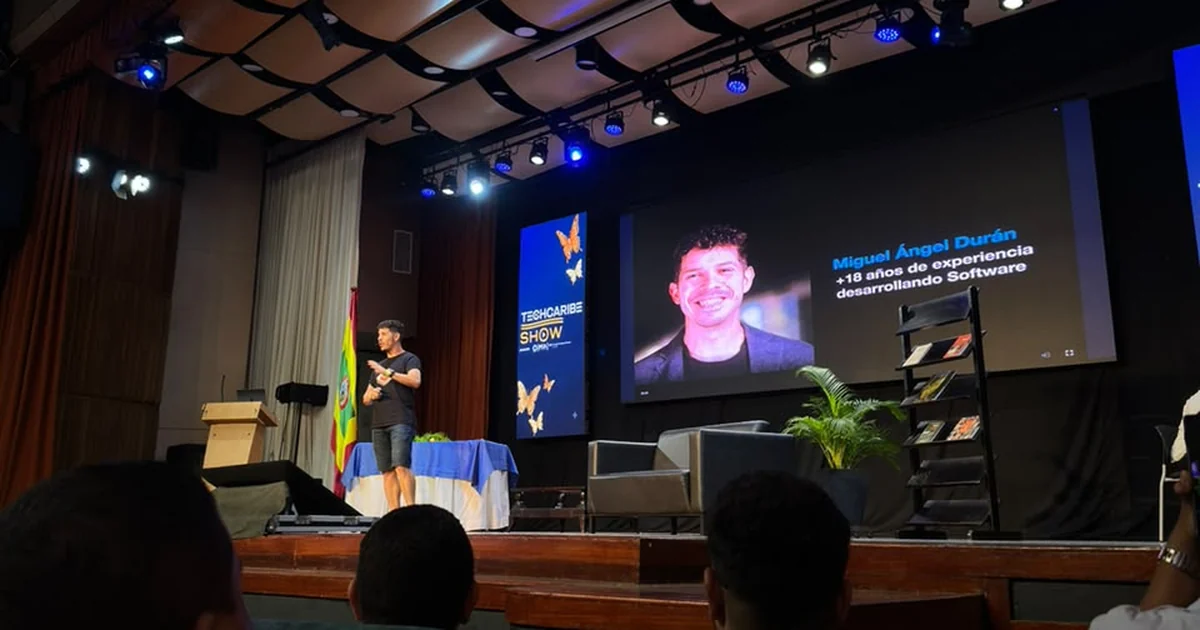
🌴 “Programming Is Dead, Long Live Programming”
That’s how midudev opened the closing session of the TechCaribe Show in Barranquilla, and I’ll admit it drew an uneasy smile out of me. We’ve all seen the headlines. Mass layoffs, that whole “AI is going to replace programmers” thing, the end of an era. I showed up as an attendee expecting yet another talk about trendy tools, but I left with an idea stuck in my head. This is less of a recap and more of what I think about it.

🤔 The Paradox That Clicked
The argument that stuck with me the most was a paradox. Despite the layoff news, demand for developers has actually grown. Why? Because when a resource like writing code becomes cheaper and more accessible thanks to AI, we don’t consume less of it, we want more. More software, more ideas turned into products, more people building.
And here’s my take. I think he’s absolutely right, but I’d add something. The bottleneck was never typing lines of code, it was deciding what to build and for whom. If AI makes the “how” cheaper, value simply shifts toward the “what” and the “why”. That doesn’t eliminate the programmer, it pushes them to think more like a problem-solver and less like someone who just writes syntax.
🦆 AI Doesn’t Make Up for Ignorance
There was one line I wrote down word for word. He said that “artificial intelligence doesn’t make up for ignorance.” And he dropped another one, even blunter. If you ship something to production and don’t understand what it does, it’s going to blow up in your face.

That’s why the rubber duck floating around the event felt perfect. Rubber duck debugging, which means explaining your code to a little duck until you find the bug, is as valid as ever, just at a different speed now. AI gives you velocity, not judgment. It can write the function, but it can’t care whether it’s correct. Understanding, questioning and being able to explain what your code does is still your job, and in my opinion it’s exactly the skill that will matter most from here on out.
⚙️ What I’m Taking Back to Practice
Beyond “AI writes code”, what genuinely excited me was seeing where things are heading:
- Local AI in the browser with WebGPU and WebLLM, with models running on the user’s own machine, with full privacy, minimal latency and zero cost.
- Not always using the most expensive model, because knowing which tool fits each use case is what really optimizes cost.
- MCP, Web MCP and MCP UI, so an agent doesn’t just reply with text, but interacts with a web page, fills out forms and generates interfaces based on context.
That’s where I see the real opportunity for those of us who build product. AI is going from being “a text box” to becoming part of the interface and the experience itself.
🤝 I Didn’t Go Alone
A detail that gets lost among all the tech headlines. I didn’t go alone. I went with two classmates from my degree, Marco Portacio and Rafael Corredor, and with professor Tobías Parodi, who joined us on an extracurricular basis, more because we’re close than out of anything formal.

And I think that’s the other point. Technology moves incredibly fast, but what actually makes you grow is still the same as always. Community, the people you share the road with, and those conversations that come up when you’re surrounded by people who love the same things you do. No model replaces that for you.
🚀 My Conclusion
Programming didn’t die, it mutated. We’re heading toward more code than ever, but generated and orchestrated with new tools. Whoever stands still waiting for AI to think for them is going to have a hard time. Whoever keeps learning and understanding will build things that were unthinkable two years ago. I choose the latter.
“Programming isn’t dead, we’re transforming it.” (midudev, TechCaribe Show)